How Many Fire Extinguishers Should a Combine Have?
A combine should have at least two fire extinguishers mounted in separate, easy-to-reach locations:
- One securely mounted inside the cab
- One mounted outside the combine where it can be reached safely from the ground
Having two extinguishers gives the operator more agent, two separate access points, and a backup if fire blocks the safest path to one unit.
But simply having two extinguishers is not enough. They need to be mounted in the right places, provide enough firefighting capability, and be ready when every second counts.
Where Should Fire Extinguishers Be Mounted on a Combine?
The exact mounting locations will vary by combine model, but each extinguisher should be:
- Easy to see
- Easy to remove from its bracket
- Securely mounted
- Protected from unnecessary damage
- Away from extreme heat and moving components
- Accessible without moving toward a fire

Inside the Cab
The first extinguisher should be securely mounted inside the combine cab where the operator can reach it quickly.
Do not leave it rolling around loose on the floor or buried behind coats, tools, paperwork, or other cab clutter.
Mount it so it does not interfere with pedals, controls, visibility, the operator’s movement, or the cab exit.
Accessible From the Ground
The second extinguisher should be mounted outside the combine where it can be reached safely from ground level.
It should be in a separate location from the cab extinguisher so smoke, flames, or heat do not block access to both units.
A ground-level extinguisher may also be easier for another worker to reach without climbing onto the combine.
Before harvest, make sure every operator knows where both extinguishers are located, how to release them from their brackets, and how to operate them.
What Size Fire Extinguisher Should a Combine Carry?
Traditional agricultural safety recommendations often call for a smaller extinguisher in the cab and a larger extinguisher accessible from the ground.
Iowa State University Extension recommends a 10-pound ABC extinguisher in the cab and a 20-pound ABC extinguisher accessible from ground level.
However, the weight printed on a traditional dry chemical extinguisher does not directly describe the capacity or performance of every type of fire extinguisher.

AKE’s Recommendation
Two STOP-FYRE® High Capacity Units
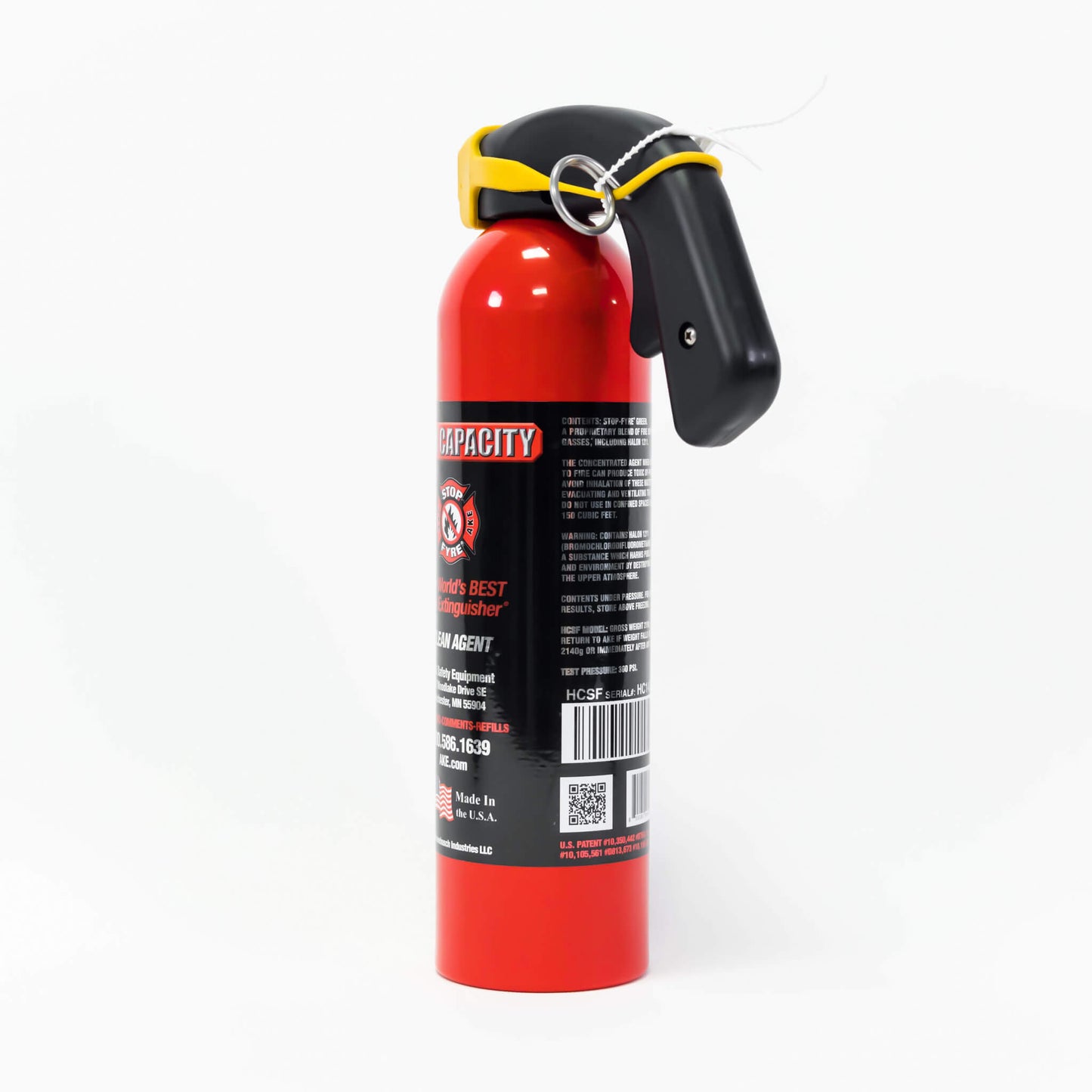
For combines, AKE recommends two STOP-FYRE® High Capacity Fire Extinguishers.
The High Capacity unit:
- Provides firefighting capability comparable to a traditional 20-pound dry chemical extinguisher
- Leaves no corrosive powder or residue behind
- Can be used in multiple short shots
- Is compact, lightweight, and refillable after use
- Requires no monthly or yearly servicing for the unit to remain functional
- Is backed by AKE’s Lifetime No-Hassle Guarantee™
Why High Capacity in both locations? Because you do not get to choose how large the fire will be, and a combine is not the place to wish you had more fire extinguishers.

Why Not Rely Only on Dry Chemical Extinguishers?
A traditional dry chemical extinguisher may help stop a fire, but it can also leave powder throughout the combine.
That powder can work its way into:
- Wiring
- Electrical connectors
- Control panels
- Sensors
- Bearings
- Engine components
- Hard-to-clean machinery spaces
After the fire is out, powder cleanup and possible secondary damage can create even more downtime.
STOP-FYRE® uses a clean agent that leaves no powder or residue behind. It is non-corrosive, electrically non-conductive, compact, and multi-shot.
That means an operator can use a short spray, stop, reassess the situation, and spray again when needed.
When you are protecting equipment you rely on to finish harvest, putting out the fire should not create another repair job.
What About the Tractor, Grain Cart, and Support Vehicles?
The combine should not be the only machine in the field carrying fire protection.
Every major piece of equipment should have dedicated protection, including:
- Combines
- Tractors
- Grain carts
- Balers
- Semis and grain trucks
- Service trucks
- Skid steers
- Pickups
- Side-by-sides
Moving one extinguisher from machine to machine leaves something unprotected.
The extinguisher sitting in the shop will not help when smoke starts rolling from a combine several miles away.
Learn more about STOP-FYRE® fire protection for farm equipment .

What Should You Do If a Combine Catches Fire?
Your safety always comes before the machine.
- Stop the combine and shut off the engine.
- Exit the cab.
- Move away from the fire.
- Call 911 and provide the exact field location.
- Only use an extinguisher if the fire is still small, conditions are safe, and you have a clear escape route.
- Stay alert for spreading flames and possible reignition.
- Back away immediately if the extinguisher is not controlling the fire.
Never climb onto or move toward a burning combine just to retrieve an extinguisher.
A handheld extinguisher is intended for a small, early-stage fire, not a machine that is already heavily involved in flames.
Check Your Combine Before Harvest
- Two fire extinguishers are mounted on the combine
- One extinguisher is securely mounted inside the cab
- The second extinguisher is accessible from ground level
- The extinguishers are mounted in separate locations
- Neither unit is blocked by tools, clothing, or equipment
- The cab extinguisher does not interfere with controls or the exit
- Both mounting brackets are secure
- Every operator knows where both units are located
- Every operator knows how to release and use them
- Every tractor, truck, and support vehicle has dedicated protection
- Operators know the field location to provide to 911
- Previously used STOP-FYRE® units have been refilled
Protect the Combine You Count On
A combine should have at least two fire extinguishers, but not just any two extinguishers.
One should be securely mounted inside the cab, where the operator can reach it quickly. The second should be mounted separately and accessible from the ground.
STOP-FYRE® High Capacity gives farmers powerful clean-agent fire protection in a compact unit that will not cover expensive equipment in corrosive powder.
It is multi-shot, leaves no mess, requires no monthly or yearly unit servicing to remain functional, and is backed by AKE’s Lifetime No-Hassle Guarantee™.
Always follow applicable equipment-manufacturer guidance, insurance requirements, workplace rules, and local fire codes.
Sources and Combine Fire-Safety Guidance
Don’t Trust Your Harvest to One Extinguisher
Protect your combine from more than one direction with STOP-FYRE®— The World’s BEST Fire Extinguisher®.
Protect Your Combine